1. A volcano beneath the limestone
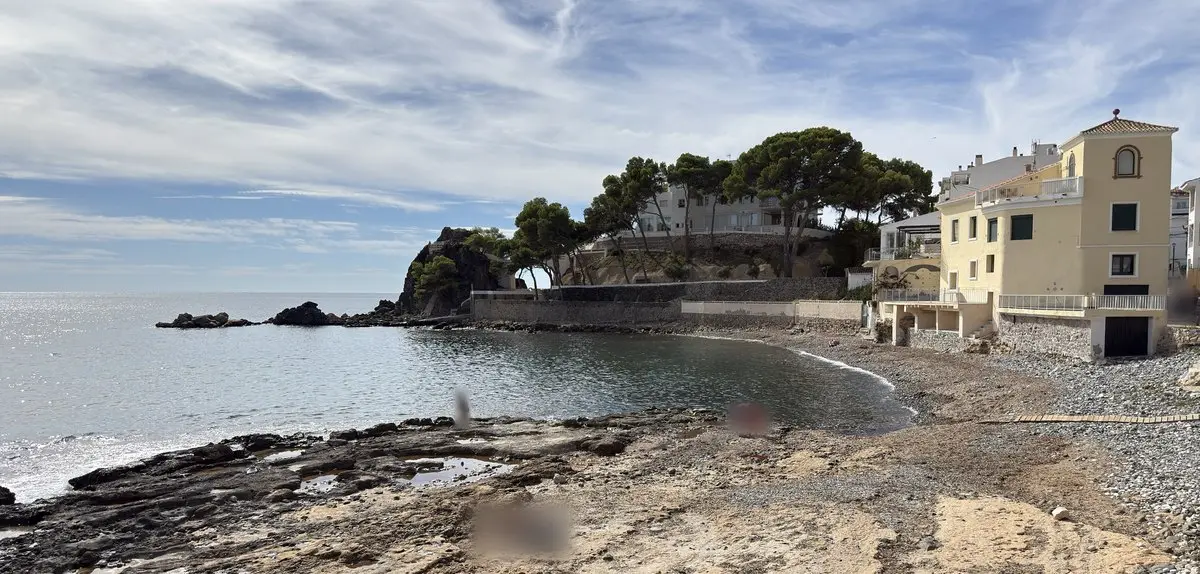
The Marina Baixa is mostly limestone. At Cap Negret, between l’Olla and the town beach, something else comes to the surface: dark igneous rock, very scarce in the Valencian region. Hence the name.
It is Upper Triassic, from the Keuper, between 210 and 225 million years old — subvolcanic diabase dykes and volcanic agglomerates of basaltic fragments. They formed in a submarine hydrothermal eruption. They reached the surface much later, and not under their own power: the Altea diapir, a rising salt dome, carried them up.
Hydrothermal alteration left behind minerals that are uncommon in volcanic rock — pistacite, prehnite, andradite and specularite. The outcrop is therefore not only conspicuous in the landscape but notable mineralogically.
2. The beach of a hundred thousand years ago
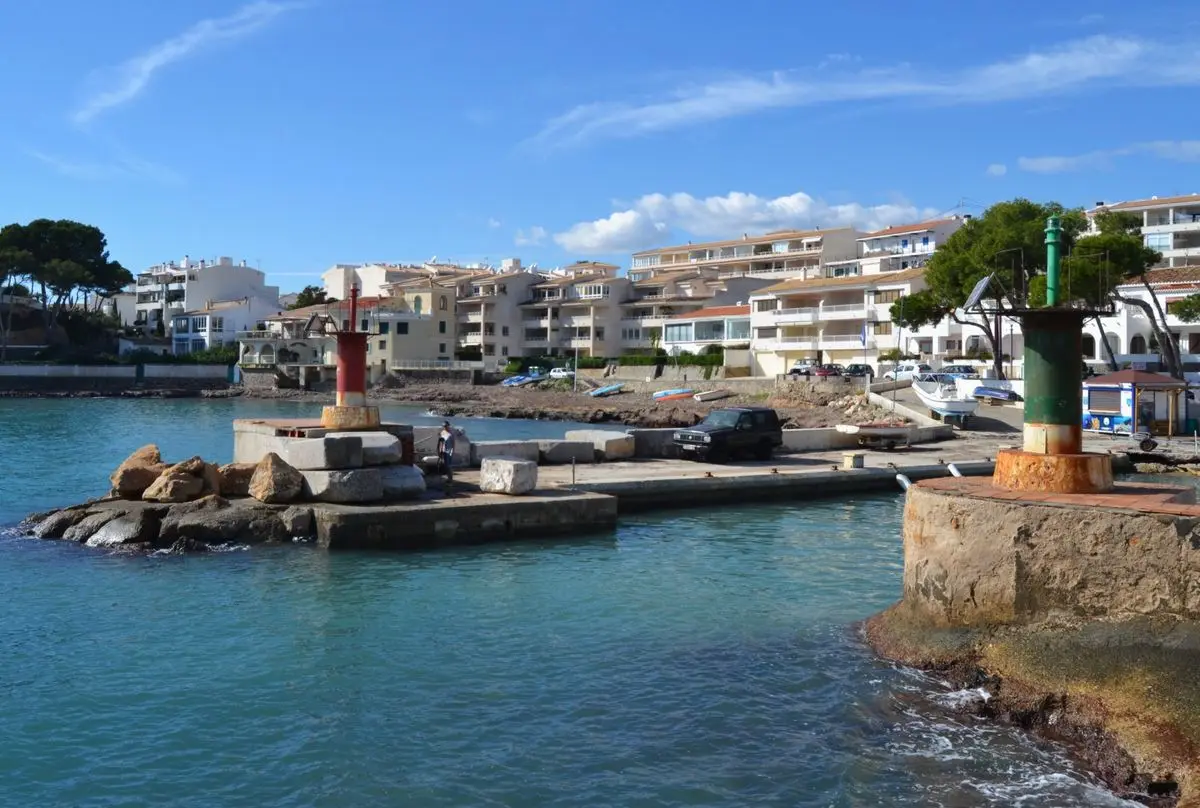
North and south of the Portet lies a marine terrace of sandstone and conglomerate. It is about 100,000 years old: a beach from the Tyrrhenian, the warm period before our own.
The rock is full of gastropods and bivalves, with serpulid and red-algal remains. The most abundant species is Strombus bubonius, a conch that today lives only in warmer seas. It is the index species of the Tyrrhenian — and with that, the evidence that the Mediterranean here was once warmer than it is now. Alongside it are Patella ferruginea, Patella caerulea, Cassis undulata, Phyllonotus trunculus, Phyllonotus brandaris and Cantharus viverratus.
A fossil beach is a benchmark: it shows where the sea stood when it was warmer. Which is why the council proposes a climate-change interpretation centre on this very spot (section 5).
3. A natural monument since 2020
By Decree 181/2020 of 13 November the Generalitat protected both together, the outcrop and the fossil beach, as the Monumento Natural del Afloramiento Volcánico y la Playa Fósil de Cap Negret de Altea. Published in the official gazette DOGV no. 8954 on 17 November 2020, under article 11 of Valencian law 11/1994 and article 34 of Spanish law 42/2007.
A considerable part of the protected area lies under water. The Conselleria left open the option of later folding the monument into the Serra Gelada nature park.
In the municipal heritage catalogue the same place appears a second time, under a different number and from a different angle: PTR 02, Entorno patrimonial de la Cala del Soio — Illeta l’Olla. See the catalogue
4. The harbour that was never built
In 2002 the operator Marina de Greenwich submitted a plan to expand the Campomanes marina: berths were to double from 500 to 1,000. The Generalitat approved it.
It was never built. The Tribunal Superior de Justicia of the Comunitat Valenciana declared the project void on 1 February 2010, and the Supreme Court dismissed the Generalitat’s appeal in cassation on 11 June 2013. That settled it.
What was at stake:
- The works would have destroyed a very well-preserved Posidonia oceanica meadow of several dozen hectares.
- Environmental groups considered the planned compensatory transplanting of the seagrass ineffective.
- Decisive for the court: the environmental impact study submitted belonged to an earlier project of 1999, not to the one actually to be built.
In 2018 the TSJ awarded the operator one million euros in compensation; it had claimed almost 93 million. The operator appealed to the Supreme Court.
5. Three harbours, three concessions
There are three harbour basins on this bay, and in all three the concession is currently in play. That is no coincidence: such concessions run for decades, and those of the 1970s and 1990s are expiring now.
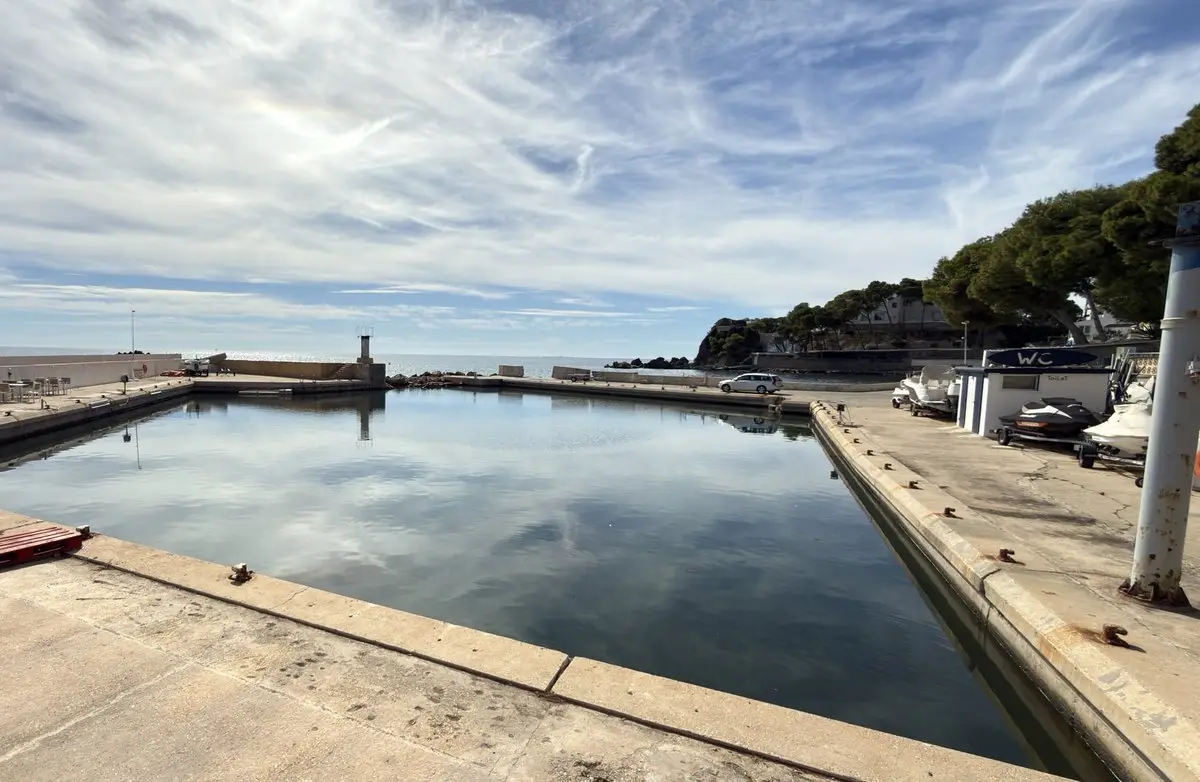
Portet de l’Olla — concession not extended
The concession ran thirty years from 17 June 1993 and ended in June 2023; the operator had applied for an extension in March 2022. The Generalitat refused it by resolution of 14 November 2025: harbour operation is incompatible with the natural monument and departs from “the spirit of protection” the legislator intended. A management plan of 31 May 2023 had already suspended any act significantly altering the physical and biological environment.
The council has applied to buy back the concession for public use, in order to conserve the Cala del Soio, and proposes the interpretation centre mentioned above, budgeted at 1.1 million euros.
Campomanes — the dispute over berths
The original concession ran fifty years, from 1976 to 2026. The operator obtained a ten-year extension and takes the view that it extinguishes the historic rights of the berth holders, who until then paid frozen rates far below the market; some had even registered their berth as property. In an opinion piece the secretary of the Club Náutico puts the company’s potential gain at around 40 million euros — his estimate, not a verified figure.
The Generalitat has been mediating since May 2026. In July a truce until 16 September 2026 was agreed: the berth holders take down their protest banner and stay away from the press; the operator stops disturbing use of the berths and may not market them until new tariffs are approved. It cannot set them on its own, though — they must be approved as public prices by the Conselleria, which says they will be moderate.
Mar i Muntanya, officially Puerto de la Galera — a new concession since 2025
154 berths. The concession was put out to tender in December 2023, annulled over errors in the documents, and re-tendered in August 2024 — now for 35 years instead of 50, at a higher annual fee. There were four bids.
The award was confirmed on 22 May 2025 to a joint venture of three companies: Nova Ática, the property group of the Valencian Llácer family; Indeisla, of Ángel Bustos, a Balearic harbour operator who built the Puerto Blanco in Calp; and Route Pont, a maritime contractor from Dénia. They offered just over 15.1 million euros of investment. Runner-up was Grupo Rover with 15.5 million — a bidder that had applied for the concession a year before the tender and plans an as yet unbuilt luxury resort nearby.
The required works include a new reception building, parking with charging points, a restaurant area, a recycling point, renewal of the pontoons — and the “reorganisation of berths for different boat lengths”.
What that reorganisation means for existing users appears in no official source. Locally it is reported that berths are becoming considerably more expensive and that owners are selling their boats. It is plausible — fifteen million has to be earned back over 35 years, and small boats yield least per metre of pontoon — but it is not documented here.
6. Sources and what remains open
Protection and geology: Decree 181/2020 of 13 November of the Consell, DOGV no. 8954 of 17 November 2020. The geological and palaeontological details follow the summary of the decree at Actualidad Jurídica Ambiental ↗ and the entry of the Generalitat Valenciana ↗.
The annulled expansion: TSJCV judgment of 1 February 2010 and Supreme Court judgment of 11 June 2013, as reported by Ecologistas en Acción ↗ and Ecoticias ↗. The environmental groups’ position and the 1999 reference project according to greenpeace.org (16 February 2010); the compensation according to eldiario.es (10 July 2018).
Portet and the berth dispute: reporting by Alicante Plaza ↗ and Moncloa.com ↗; the Galera award according to Alicante Plaza ↗.
Concessions: the council’s application to buy back the Portet according to alicanteplaza.es (12 December 2022); term since 1976 and ten-year extension of the Campomanes concession according to elespanol.com (11 November 2025).
What remains open. The Campomanes truce expired on 16 September 2026. Whether a tariff agreement was reached or the dispute goes to court could not be established from the available sources. Equally open: whether the Portet operator challenges the refusal, and what the reorganisation of berths at La Galera will cost existing users.
Compiled October 2026. Dates and deadlines come from official resolutions and the linked press. Proceedings under way change; what is given here reflects the position at the time of compilation, not necessarily today’s.